
Author: Jessie Satovsky
Editors: Darby Osborne, Victoria Maza
Are critical minerals the world’s next resource curse? As the global economy becomes increasingly dependent on advanced technologies and clean energy systems, demand for critical minerals is accelerating rapidly. Critical minerals are minerals categorized by their importance as components of various manufactured goods; the U.S. Geological Survey publishes an updated list of qualifying minerals every three years. As of the 2022 list, there are 50 “critical minerals,” including minerals such as lithium, nickel, cobalt, aluminum, and various rare earth elements. These minerals are necessary components of advanced technologies, including smartphones, medical imaging equipment, guided missile systems, and clean energy technologies such as solar panels and wind turbines.
The mining and production of critical minerals is projected to grow substantially through 2040, driven by rising digitalization and decarbonization efforts. Demand for critical minerals used in clean energy technologies alone is expected to increase more than fourfold by 2040, with demand for lithium and graphite projected to more than double (see Table 1 and Figure 1 below). While this demand underpins the global energy transition, it also creates significant economic, environmental, and human rights risks for many countries that export minerals. Adequate governance and policy safeguards are vital to prevent the critical mineral trade from reproducing patterns seen in fossil fuel economies—often called a “resource curse.” A resource curse is when resource-rich nations face economic volatility, environmental degradation, and weakened political autonomy. Addressing these risks is crucial for policymakers aiming to harness the benefits of the mineral trade without replicating historical harms.
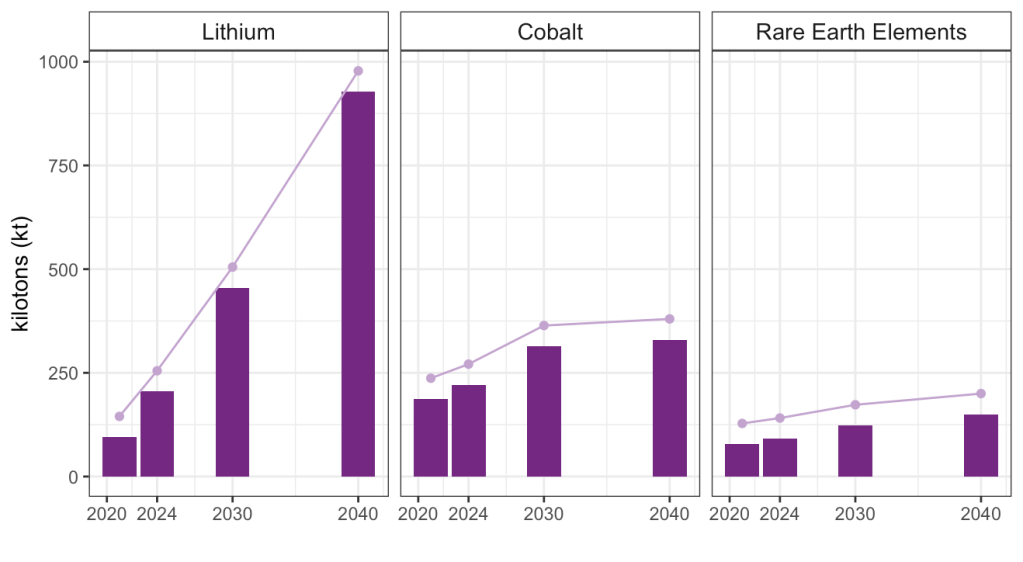
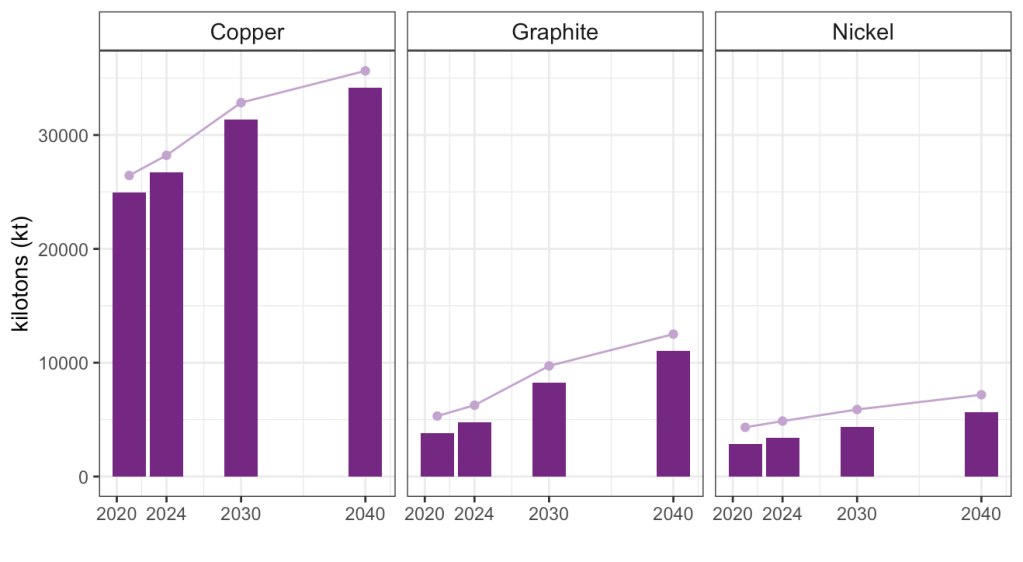
Figure 1. Demand outlook for key minerals, 2020-2040
Note: The light purple lines are meant to highlight demand trends over time, and are not a separate measurement.
Source: International Energy Agency (2025).
Table 1. Global demand outlook for key minerals (measured in kilotons (kt))
| Year | Cobalt | Copper | Graphite | Lithium | Nickel | Rare Earth Elements |
| 2021 | 187 | 24,946 | 3,813 | 95 | 2,825 | 78 |
| 2024 | 221 | 26,717 | 4,766 | 205 | 3,371 | 91 |
| 2030 | 314 | 31,348 | 8,219 | 455 | 4,389 | 123 |
| 2040 | 330 | 34,137 | 11,010 | 928 | 5,685 | 150 |
Source: International Energy Agency (2025).
Economic diversification is crucial to prevent critical minerals from enriching consumer nations at the expense of exporters. Economic diversification refers to shifting a nation’s economy away from reliance on a single source of income (the critical mineral trade) to multiple, by investing in other economic sectors. Many countries that are exporters of raw resources have developing economies, such as Myanmar, the Democratic Republic of the Congo, Mozambique, Chile, South Africa, Zimbabwe, and Kazakhstan. A heavy focus on mineral development and trade may lead these countries to overinvest in the critical mineral industry at the expense of other sectors, making exporting nations overly reliant on economic activity related to minerals. This overreliance exposes these nations to price volatility.
Additionally, major raw critical mineral consumers such as the United States, the European Union, and China are putting increasing pressure on exporting countries to mine more minerals at advantageous prices. Power imbalances in economic capacity, military influence, and technological expertise make it difficult for resource-rich countries to resist these demands and secure profitable deals. For example, though Zimbabwe is rich in lithium, the country does not have the technology or expertise to produce it. As a result, Zimbabwe remains dependent on foreign markets and is often forced to sell minerals at prices set by consumers. Strategic trade partnerships and long-term economic planning are therefore critical to reducing these structural inequalities and stabilizing global mineral markets.
The mining of critical minerals alone is also economically and environmentally damaging. For example, the mining of rare earth elements involves removing fertile topsoil and adding toxic chemicals to the dig site to isolate the minerals. This creates ponds of toxic chemicals that can seep into the groundwater and make the area uninhabitable. This pollution destroys local vegetation, fragments habitats, disrupts ecosystem services, and allows chemicals to leach into groundwater and the air.
Bayan-Obo, China’s largest rare earth mine, is an instance of this environmental pollution. The mine has a waste pond containing over 70,000 tons of radioactive thorium. Due to improper lining, the chemicals are drifting towards the Yellow River, a crucial source of drinking water and irrigation. Beyond destroying vegetation and making the area uninhabitable for animals, this dispersion of chemicals into the air and water can cause acid rain, cardiovascular disease, and respiratory problems. Additionally, workers at these mines are often overworked, underpaid, and face health complications from exposure to toxins.
Furthermore, Mineral production requires intensive water use and is a source of greenhouse gas emissions, contributing to climate change and regional water shortages. These issues compound with economic risks: as nations compete to produce more minerals at low costs, they are incentivized to cut costs related to safe mining and production practices, accelerating environmental destruction, pollution, and mistreatment of workers. This will negatively affect large parts of these countries’ economies by reducing the number of healthy workers, destroying agricultural areas, hurting important natural resources, and even reducing tourism. Environmental regulations and cleanup measures are essential to reduce these impacts.
Despite the externalities from mineral production, technologies that utilize minerals, like clean energy, have many benefits, such as reduced greenhouse gas emissions compared to fossil fuels. Careful governance over the critical mineral trade is essential to supporting these new technologies while preventing negative externalities from mineral production and trade. Addressing these risks now is crucial and will be far more effective than attempting to remedy entrenched harms later.
To avoid replicating the economic, environmental, and governance failures associated with fossil fuel extraction, countries must establish clear guardrails around critical mineral development and trade. In the short term, these guardrails should include stronger international partnerships through trade agreements and enforceable environmental and labor standards for mineral extraction and processing. Long-term, countries should prioritize economic diversification and expanded investment in recycling technologies to reduce reliance on primary mineral supply. Responsibility for initiating these reforms lies primarily with major consumer economies such as the United States, the European Union, and multinational firms, which possess significant leverage through trade policy, procurement standards, and due diligence requirements. By conditioning market access and investment on compliance with environmental and labor standards, consumer countries can incentivize exporters to improve governance practices without shifting extraction to less regulated markets.
As global demand for critical minerals continues to rise, the window for proactive policy intervention is narrowing. Ensuring that the digital and clean energy transitions do not replicate the extractive and unequal development patterns of the past requires coordinated action across governments, markets, and civil society. By acknowledging the structural risks of critical mineral dependence and acting collectively to mitigate them, countries can help ensure that the transition to a digitalized and low-carbon future is both just and sustainable.
 Emory Environmental Report
Leave a comment